Fixed queries over flexible CLI
Operational usefulness comes from consistent evidence, not from recreating a terminal in the browser.
MacDaddy module / observability
Search and classify switch logs across an inventory scope without turning a convenient web interface into an arbitrary remote command runner.
Network devices have limited local log space, so the evidence I needed could roll away before a pattern became obvious. Opening device after device also made it hard to tell whether an event was isolated or happening across the fleet.
LogNinja consolidates that evidence. It resolves approved targets from inventory, runs a fixed read-only command set, streams progress, classifies known event families, tracks collection health, and retains searchable evidence so I can pinpoint recurring issues faster.
I did not build a web terminal. The browser can choose a supported search mode, but it cannot send an arbitrary command string to a switch. Consistent evidence was more valuable—and safer—than unlimited flexibility.
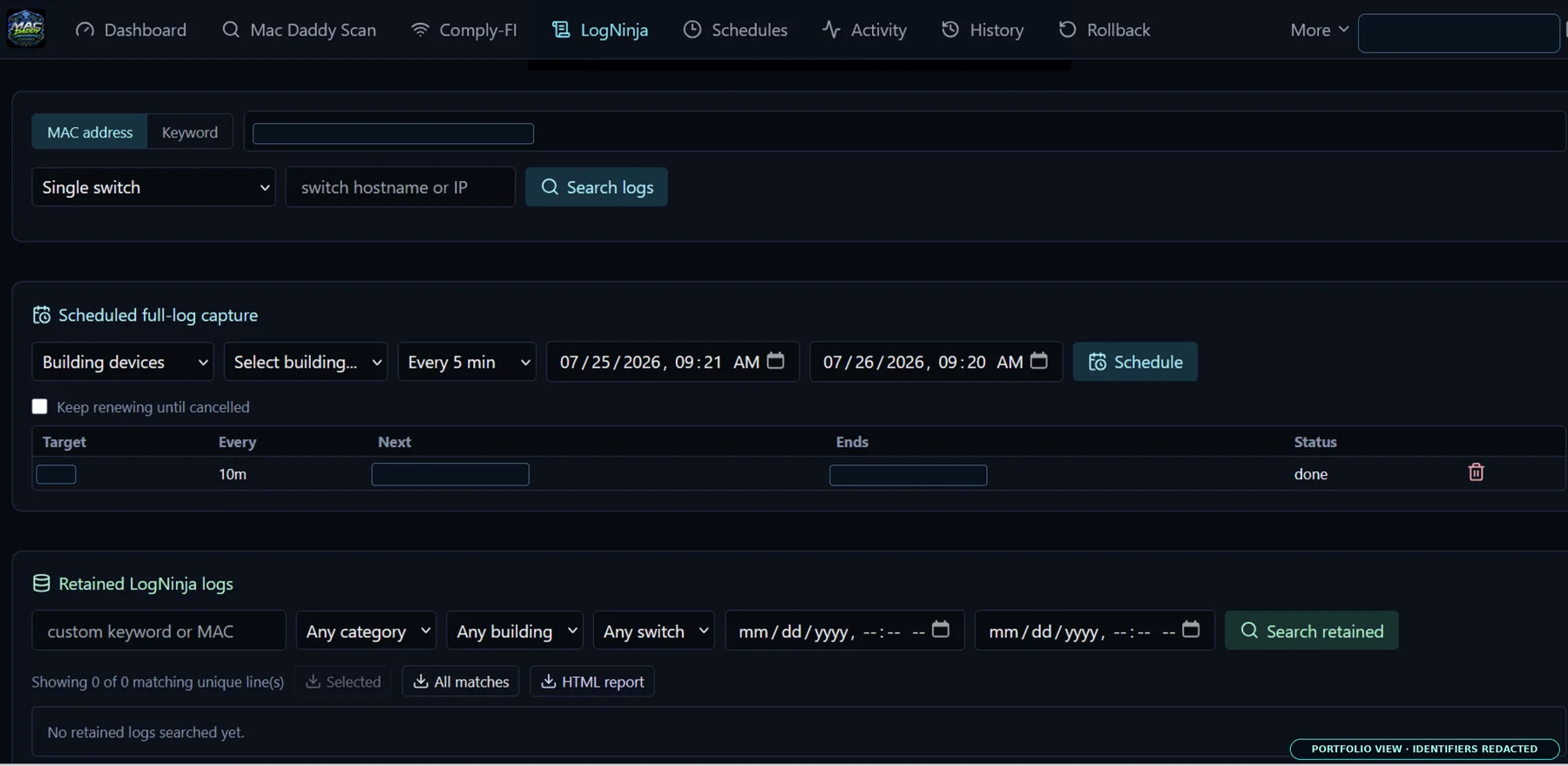
Search UIValidated mode, scope, filters, schedules, progress, retained evidence, export.
Target resolverConverts approved inventory scope into a bounded device set.
CollectorRuns only static read-only commands with cancellation and output limits.
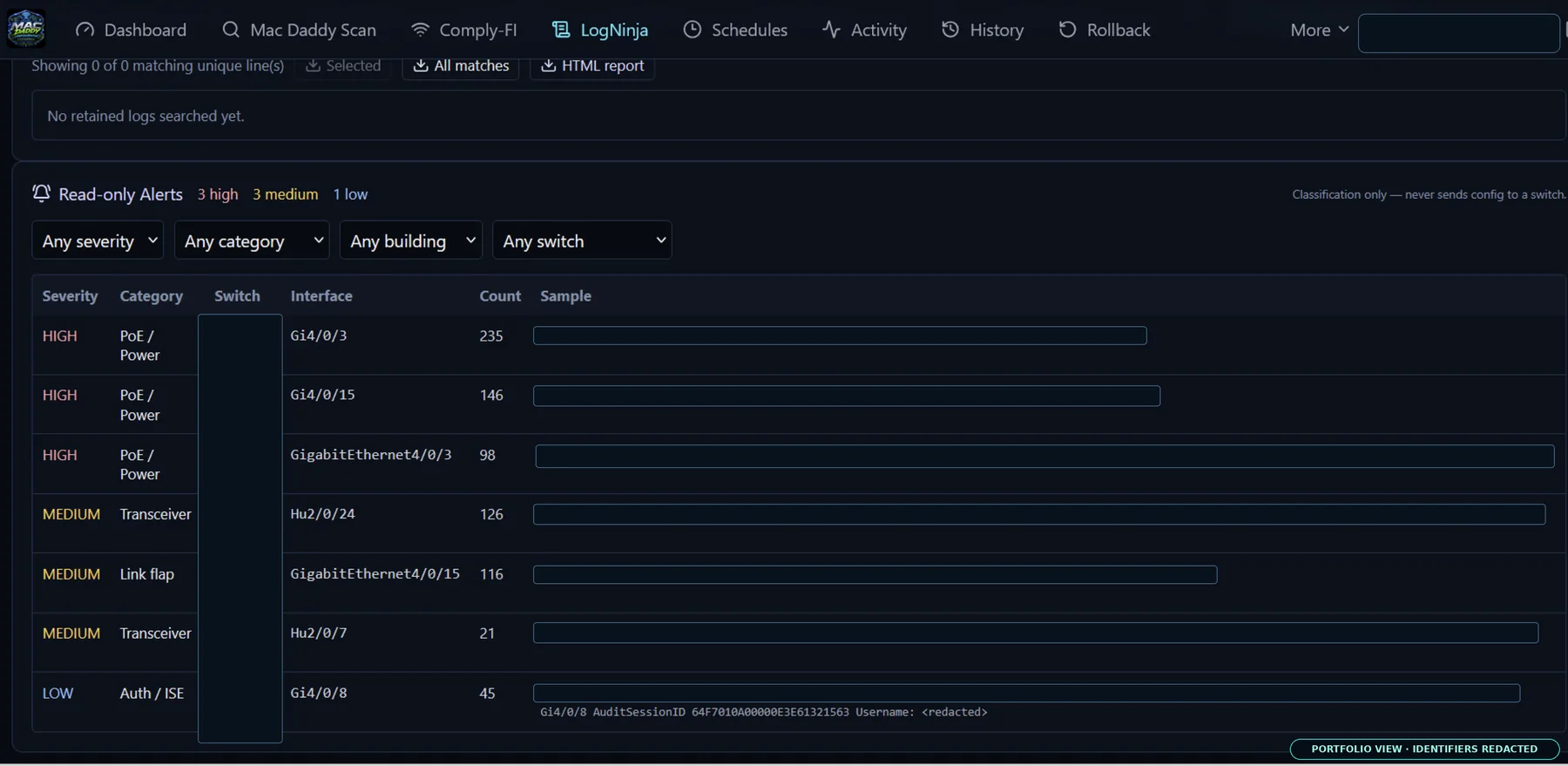
ClassifierParses timestamps, severity, event family, device, and collection health.
RetentionPersists searchable lines and prunes them according to configurable policy.
Resolve a device or inventory-backed group; global work receives a separate confirmation.
Collect read-only log evidence with shared resource limits and cancellation support.
Identify link, authentication, power, spanning-tree, and informational events.
Keep unreachable and unhealthy devices visible so missing data is not mistaken for a quiet network.
Retain lines for later filtering, schedule repeat captures, and export a sanitized report.
Operational usefulness comes from consistent evidence, not from recreating a terminal in the browser.
Repeated collector failures remain searchable so a gap in evidence cannot look like an absence of events.
Recurring collection can renew only while the creator remains authorized and encrypted credentials remain available.
A safe demonstration can replay link flap, authentication, power, spanning-tree, benign, and unreachable-device fixtures through the classifier—without any device connectivity.
Fleet observability needs two parallel answers: what did the devices report, and which devices failed to report at all? Treating both as first-class evidence prevents false confidence and makes schedule gaps diagnosable.